Dot peen marking is a reference marking technology designed to ensure permanent part identification, thanks to a deep and durable marking.
This process creates a deep mechanical indentation marking, ensuring long-lasting readability after standardized abrasion tests, impact resistance tests, or industrial washing cycles.
Dot peen marking meets long-term traceability requirements by enabling the direct marking of serial numbers, references, and DataMatrix codes directly onto the part. This ensures accurate and reliable reading by machine vision systems, even after surface treatments or in harsh industrial environments.
Dot peen marking requires the adjustment of several parameters (impact force, dot density, stylus angle, stylus-to-part distance, marking speed) depending on the material and its surface condition.
Whether for portable applications, fixed production environments, or automated systems, SIC MARKING offers solutions tailored to all industrial sectors.
This versatility, combined with the ability to customize marking parameters according to materials and specific requirements, makes dot peen marking a key technology for ensuring reliable identification, long-term traceability, and optimal resistance to harsh conditions.
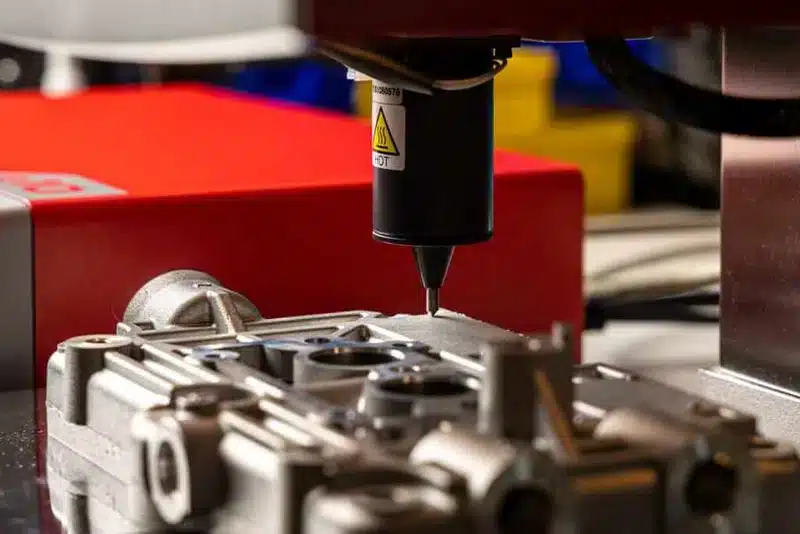
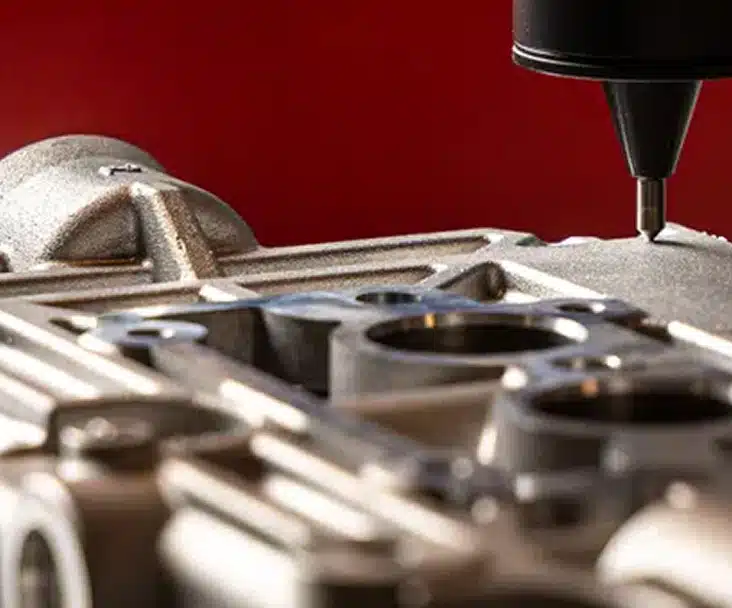
Based on controlled impact, the dot peen marking machine generates a sequence of impact dots that form a durable indented marking.
The impact force is adjusted to achieve the desired marking depth.
In practice, the typical depth ranges from a few micrometers to several hundred micrometers, depending on the material and the application.
In addition, the marking density can be adjusted by modifying the spacing between the impact dots.
Dot peen marking is an extremely effective marking solution for a wide range of parts, whether they are flat, cylindrical, complex, small, large, or feature hard-to-access areas.
It ensures precision and durability of the markings.
Thanks to its flexibility, this marking technology adapts to the geometry and size of parts, delivering repeatable and reliable markings for applications such as identification, traceability, and industrial compliance.
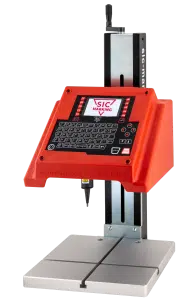
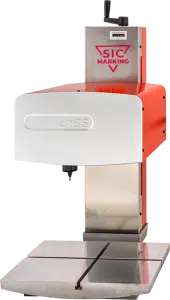
The choice of the marking solution (fixed dot peen marking station, portable dot peen marking machine, integrable dot peen marking machines, and various accessories such as a rotary axis or dedicated fixtures) depends on several factors: part shape, accessibility, and production volume. Each situation requires a specific approach to ensure optimal marking.
Series production
Heavy and immovable parts
Complex geometries
Dot peen marking is particularly well suited for ferrous metals (such as carbon steels, stainless steels, and cast irons) and non-ferrous metals (such as aluminum, copper and their alloys), as well as certain rigid technical plastics such as POM, PA, and PEEK, which are sufficiently impact-resistant to ensure durable marking.
Ferrous metals
Non-ferrous metals
Technical plastics
Non-compatible materials
Dot peen marking offers a comprehensive range of markings, from alphanumeric markings, 1D/2D codes, regulatory markings, to technical references and deep markings, ensuring permanence, readability, and resistance to harsh conditions.
Thanks to the adaptability of dot peen marking machines to materials and complex geometries, this permanent marking technology allows adjustment of marking depth and positioning to meet machining, assembly, and environmental constraints.
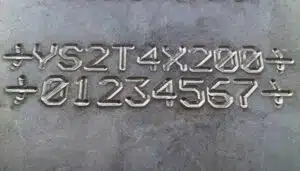
Mainly used for serial numbers, product references, and identification codes, alphanumeric marking by dot peen allows engraving series of characters with a specific height and controlled depths, depending on the material.
This marking is suitable for industrial conditions such as abrasion, high temperatures, and chemical agents, while remaining readable for both human and automatic reading.
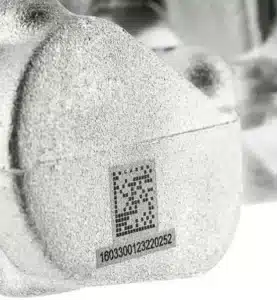
Dot peen marking can generate 2D matrix codes such as DataMatrix, which are suitable for a wide range of surfaces.
The DataMatrix is particularly well suited for surfaces requiring high information density, such as in the aerospace and medical sectors.
The DataMatrix ECC200 is the standard for industrial components due to its robustness and compactness.
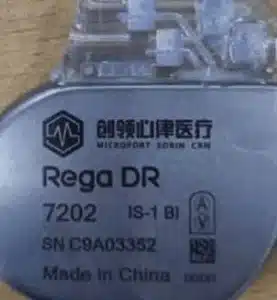
Dot peen marking meets the traceability and identification requirements imposed by sector regulations, such as EU Regulation 2017/745 (MDR) for medical devices, the UDI rules from the FDA, as well as quality standards like ISO 9001, ISO 13485, or IATF 16949 in the automotive industry. These markings often need to be permanent, readable after aging, and resistant to abrasion or corrosion tests.
Dot peen marking technology allows for marking depths ranging from a few micrometers up to several hundred micrometers, sufficient to pass standardized tests such as salt spray testing according to ISO 9227 in certain cases.
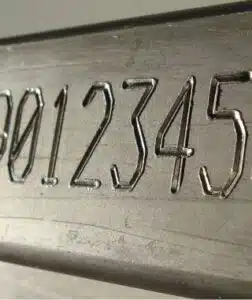
Dot peen marking allows for deeply engraved markings in the material, ideal for serial numbers on metal parts, codes on engines, and industrial tooling. These markings have typical depths depending on the material and marking parameters, ensuring readability even after processes such as machining, painting, sandblasting, or heat treatments.
Dot peen marking ensures long-lasting traceability, essential for regulatory compliance (such as UDI requirements or automotive traceability) and maintenance.

In the automotive industry, dot peen marking is used to mark serial numbers, barcodes, and product references on metal parts and engine components. It ensures traceability and durability, which are essential in high-volume production environments where markings must withstand heat treatments and surface treatments such as sandblasting or painting. The technology is ideal for applications such as body parts, engine blocks, and structural elements, where consistent readability is required to ensure compliance and long-term maintenance.

In the aerospace sector, dot peen marking is used to mark engine components, metal structures, and critical parts used in aircraft. Markings are performed to ensure full traceability throughout the production chain and during maintenance inspections. The precision of dot peen marking allows engraving serial numbers or DataMatrix codes on parts subjected to extreme working conditions, such as metal components, supports, housings, and structural parts, while complying with strict compliance and safety standards, such as those required by AS9100.

In the railway sector, dot peen marking is used to mark bogie components, identification plates, and structural parts such as rails or braking systems. These markings are essential to ensure traceability and maintenance of parts over time, providing quick identification in complex production and maintenance environments. The marked codes are often paired with serial numbers or 2D codes to facilitate inventory management and compliance verification throughout the equipment’s lifecycle.
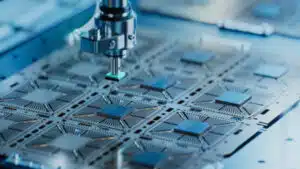
In the electronics sector, dot peen marking is used to mark electronic components such as electronic housings, metal chassis, and nameplates. These markings are essential for traceability of parts within production lines and to facilitate repairs or modifications in service. DataMatrix codes can be engraved as they allow information storage on small and complex surfaces, ensuring readability and durability even after rigorous testing or heat treatments.
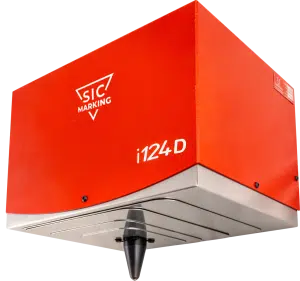
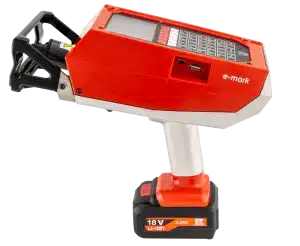
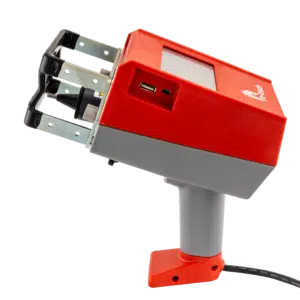
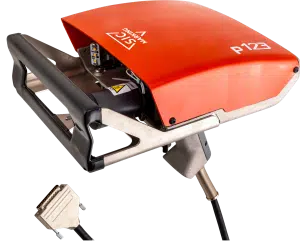
Discover our key dot peen marking equipment: Portable machines, Integrable modules for production lines, or Standalone marking stations.
Contact Us
Need information?
Get in touch with one of our experts!