Pattern hero


Steel Marking


A key material in the industrial sector, steel stands out for its unique balance of hardness, ductility, thermal conductivity, and corrosion resistance — properties that vary depending on its composition.


As a ferrous-carbon alloy enriched with additional elements, it offers a high level of adaptability through heat treatments (quenching, tempering, annealing) and the addition of alloying elements to optimize performance according to application requirements.

Depending on steel hardness, surface finish, production environment, or the expected type of marking (Data Matrix, serial number, deep marking…), SIC MARKING offers several families of engraving machines for steel:
 

  • Laser engraving machines for steel: standalone laser stations, integrated laser heads for automated lines, or compact lasers for semi-automatic workstations,
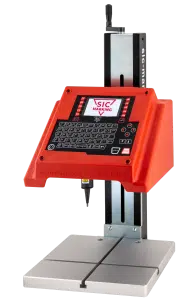
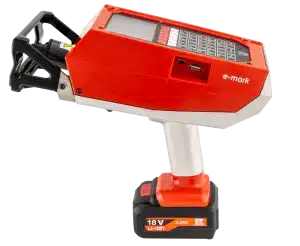
  • Steel marking machines by micro-percussion: portable dot-peen machines for large parts, standalone fixed stations for repetitive series, or integrated dot-peen heads for high-speed marking,
  • Steel marking machines by scribing: standalone scribing units for deep marking of massive parts, scribing heads integrable into robotic cells, or dedicated deep marking solutions for VIN / chassis.


machine de marquage sur acier

Criteria for Choosing Steel Engraving Technology


The selection of engraving technology for industrial steel parts is based on several criteria: hardness, surface finish, composition, thickness, thermal sensitivity, and the expected level of contrast.


Its homogeneous surface, excellent absorption of the laser beam, very high impact resistance for dot peen marking, and wear resistance for scribing make it an ideal material for the most demanding marking applications.


Steel therefore ensures optimal readability of DataMatrix or QR codes, high durability in harsh environments, and compatibility with all surface finishes.


  • Laser engraving on steel is suitable for all hardness levels and is perfectly adapted to thin parts. Laser marking generates black-and-white contrast and offers improved readability on rough surfaces.
  • Steel marking by dot peen performs exceptionally well on smooth or polished surfaces.
  • Steel scribing enables deep and sharp markings on medium-hard steels.

Steel Hardness

Surface Finish

Steel Composition

Part Thickness

Thermal Sensitivity

Expected Contrast

Pattern hero

Types of Steel Marking


Steel is suitable for all types of permanent marking: alphanumeric, 2D codes (Data Matrix), QR, barcodes, logos, or deep markings.


The choice of steel marking technology depends on the application and any post-marking treatments (painting, galvanization, machining).


Laser engraving on steel provides high resolution, dot peen marking ensures excellent marking durability, and steel scribing allows for deep, long-lasting markings.
fabricant station de marquage alphanumérique
Steel

Alphanumeric Marking


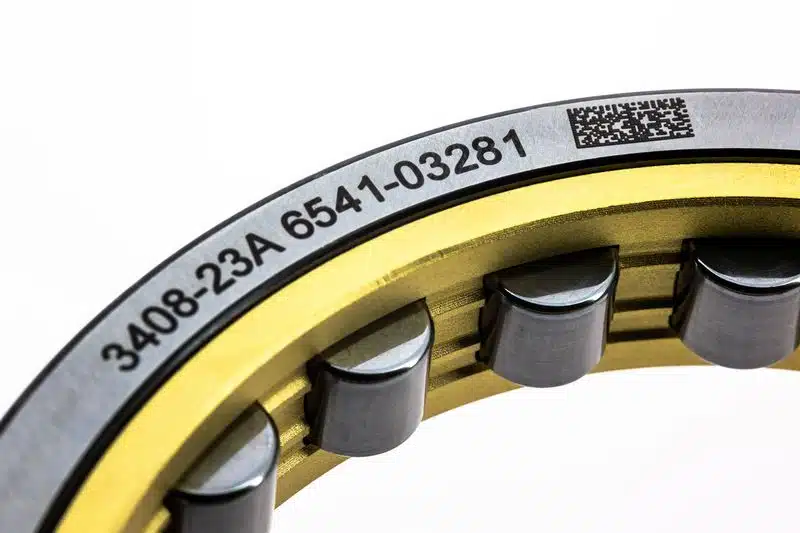
Alphanumeric markings are the foundation of industrial traceability: serial numbers, batch numbers, part identifiers, internal references, or variable data such as date, time, or counters. Serial numbers typically range from 6 to 12 characters, while internal references range from 4 to 10.


Generally, 2 to 5 mm characters are used for comfortable human reading, and smaller sizes (0.3 to 1 mm) for automatic reading systems.


  • Laser engraving on steel provides fine precision (typical resolution up to ~0.05 mm) and excellent contrast on stainless steel and treated steel, making it ideal for small characters and 2D codes.
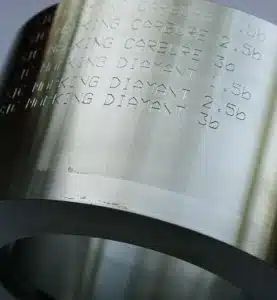
  • Dot peen marking on steel creates a durable indentation, often chosen for parts to be painted or exposed to abrasion, while steel scribing (engraving) achieves depths over 0.2 mm for extreme long-term durability.

In practice, laser marking is commonly used for Data Matrix marking; the laser remains the reference solution for marking steel after painting and for compliance with DPM requirements on specific parts.

  • Steel scribing is preferred for VINs, beams, or forged parts.


When choosing a steel marking technology, factors considered include surface condition (polished, brushed, painted), part thickness, and integration with vision systems and ERP.
station de marquage Datamatrix
Steel

2D Data Matrix Code


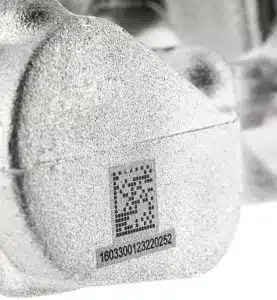
ECC200 Data Matrix codes, widely used in automotive, aerospace, and pharmaceutical sectors, allow encoding large amounts of information in a very small space (2 to 10 mm).


Properly configured, they remain readable even after painting or galvanization, with modules generally ≥0.25 mm to ensure reliable reading.


On steel, their performance is excellent: thousands of parts can be marked with read rates exceeding 99%. In production, these codes integrate directly with control systems and tracking tools such as MES, facilitating logistics and maintenance.


  • Fiber laser engraving is the reference solution for marking Data Matrix on steel due to its high contrast, speed, and repeatability.
  • Dot peen marking remains a robust alternative for demanding environments but requires larger modules and provides lower contrast.
  • Steel scribing is rarely suitable for very dense codes. To ensure proper reading, each configuration (multiple readers, variable lighting) should be validated and contrast criteria respected.
STEEL

QR Code


Less commonly used than Data Matrix, QR codes are preferred when smartphone or tablet reading is desired. Their high capacity (up to over 4,000 characters) allows direct encoding of URLs and detailed information.
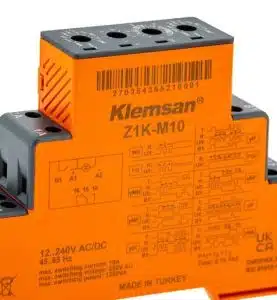
 

  • Fiber laser engraving is the preferred solution for QR codes on steel: it provides fine resolution, high contrast, and allows compact modules (generally ≥ 0.4–0.5 mm). 20–50 W fiber sources are common, and MOPA lasers are used when precise pulse control is required, especially on stainless steel.


station de marquage de code barre & QR code
Steel

1D Barcode


1D barcodes remain widely used for linear identification of steel parts, particularly in logistics and spare parts management.


The most common formats are Code 128, Code 39, and EAN, capable of encoding 10 to 20 characters. Laser engraving on steel with a line thickness of 0.15 to 0.25 mm generally ensures reliable reading.


They are well suited for assembly lines equipped with short-range fixed readers. Laser marking allows rapid marking (up to 1–2 codes per second), while dot peen, though slower, provides better durability in abrasive environments.
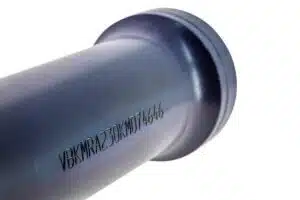
 

  • Laser marking is the preferred solution for barcodes on steel when line precision is critical: it provides high contrast, sharp lines, and excellent repeatability.


machine laser de marquage profond de l'acier
Steel

Deep Marking on Steel


For applications where durability is critical, deep marking is the preferred solution: it remains legible after machining, painting, sandblasting, or galvanization.


In the automotive sector, deep marking is primarily used for VIN on chassis, where continuity and depth of the mark are essential for compliance and anti-fraud purposes.


In structural steel and offshore, beams and flanges are deeply marked to remain readable after sandblasting and painting, while resisting thermal cycles and corrosion.


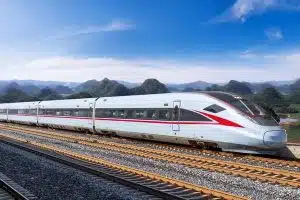
The railway and machine tool sectors also use deep marking for forged parts and safety components, with minimum depths specified in technical requirements. These robust markings ensure long-term traceability and prevent costly replacements.


  • Mechanical engraving on steel is the most effective method to achieve high depths, typically between 0.2 and 0.5 mm depending on the steel hardness.
  • Dot-peen marking on steel offers a good balance of durability and speed, with depths of 0.05 to 0.6 mm and high industrial throughput.
  • Laser engraving on steel can perform deep marking using multipass techniques, but remains limited to approximately 0.01–0.2 mm, increasing cycle time. It is useful when fine character resolution is important, but beyond 0.3 mm depth, mechanical engraving or high-powered dot-peen is preferable.


In practice, the choice of permanent steel marking technology depends on constraints: engraving is favored for forged parts exposed to sandblasting, while dot-peen marking is suitable for painted parts.
machine de marquage pour logo
Steel

Logo and Pictogram


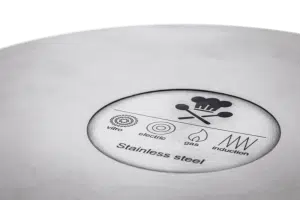
  • Laser engraving on steel is preferred for logos and fine details: a 20–50 W fiber laser can produce lines of 20–50 µm and logos readable from 1.5 mm, ideal for nameplates or molded parts.
  • For maximum durability against treatments (sandblasting, galvanization), a deep-engraved logo using mechanical engraving remains more robust than laser marking.


The choice also depends on the application: pictograms that must remain visible after painting are often produced using dot-peen marking, while compliance symbols require precision and contrast via laser marking.

Pattern hero

Applications by Industrial Sector


Steel, thanks to its robustness, hardness, and dimensional stability, is perfectly suited for permanent marking using laser engraving, dot-peen marking, or mechanical engraving. These steel marking technologies ensure long-lasting readability even in harsh environments while meeting the compliance requirements of the automotive, aerospace, railway, energy, medical, and defense sectors.


Depending on the requirement, the marking can be very deep, high-contrast, or extremely fine to accommodate industrial constraints.
machine de marquage pièce automobile

Automotive & Mobility


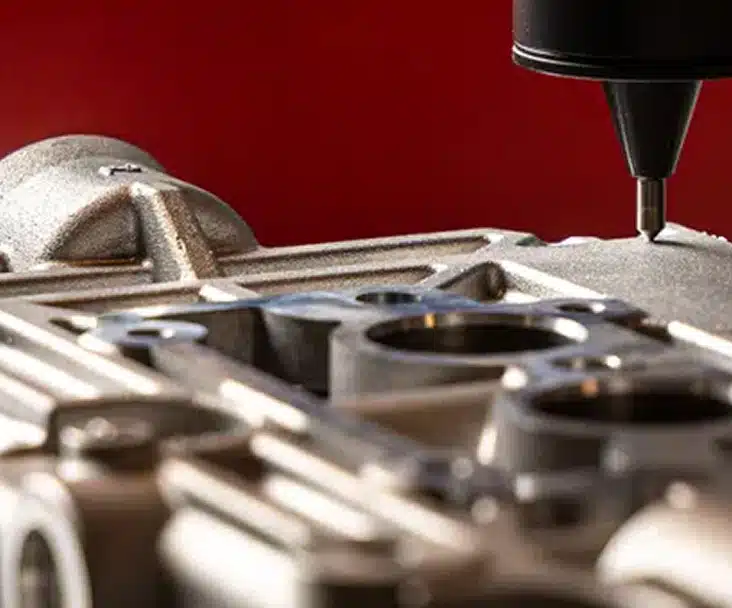
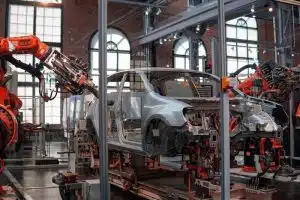
  • Engine number engraving (engine block, cylinder head, oil pan) : laser technology engraving or micro-percussion marking of serial numbers / alphanumeric codes / Datamatrix.
  • Shock absorber reference marking (sleeves, rods, steel body) : laser engraving of product references / barcodes / Datamatrix.
  • Identification of connecting rods, shafts or gears : micro-percussion marking of forged steel parts – lot number, Datamatrix, internal manufacturer code.
  • Chassis & engine sub-frame components : deep marking by engraving of structure numbers for durable readability and paint resistance.
Machine de marquage pour pièce aéronautique

Aeronautics


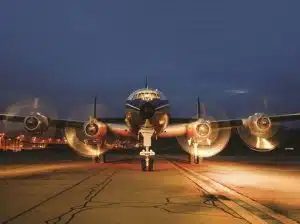
  • Critical steel part engraving (landing gear) : micro-percussion marking with a specialized stylus for serial numbers and Datamatrix without mechanical impact, ensuring stable marking on high-strength steel.
  • Structural attachment marking (fitting, hinge…) : micro-percussion marking of Datamatrix for machined steel parts, and micro-percussion marking of structural reference for forged steel parts.
  • Tool marking (maintenance tool, template) : micro-percussion marking of certification logos and QR codes, ensuring black, legible, non-deforming marks.
  • Forged component marking (support, shaft, joint) : micro-percussion marking of lot references and traceability codes, providing high mechanical durability in harsh environments.
machine de marquage pièce ferroviaire

Railway


  • Bogie part marking (chassis, crossbeams, frames, axle boxes) : marking by engraving of serial numbers and maintenance codes for a deep, lifetime-readable mark.
  • Engraving of axles, shafts and railway trees : laser engraving on machined steel surfaces for Datamatrix codes, and micro-percussion marking of identification numbers.
  • Coupling and interconnection component marking : engraving marking of lot numbers and assembly numbers, ensuring corrosion-resistant treatments and continuous deep marking.
  • Painted steel part marking (longerons, chassis elements) : engraving marking of structural serial numbers and Datamatrix codes.
machine de marquag pour secteur énergie

Energy, Oil & Gas


  • Steel flange marking (ANSI, API, DIN) : deep engraving of lot numbers and Datamatrix codes on rough surfaces, ensuring resistance to saline environments.
  • Valve and industrial tap marking : micro-percussion marking on raw surfaces of manufacturer references and serial numbers for readability despite deposits and abrasion.
  • High-pressure steel fitting marking : engraving marking of serial numbers for readable marks after sandblasting.
  • Steel pipeline marking : portable micro-percussion marking on large steel tubes.

Contact Us
Need more information?
Get in touch with one of our experts!
+82 317318400
Contact us info@sic-marking.co.kr